Things I didn’t know before buying my (awesome) EV
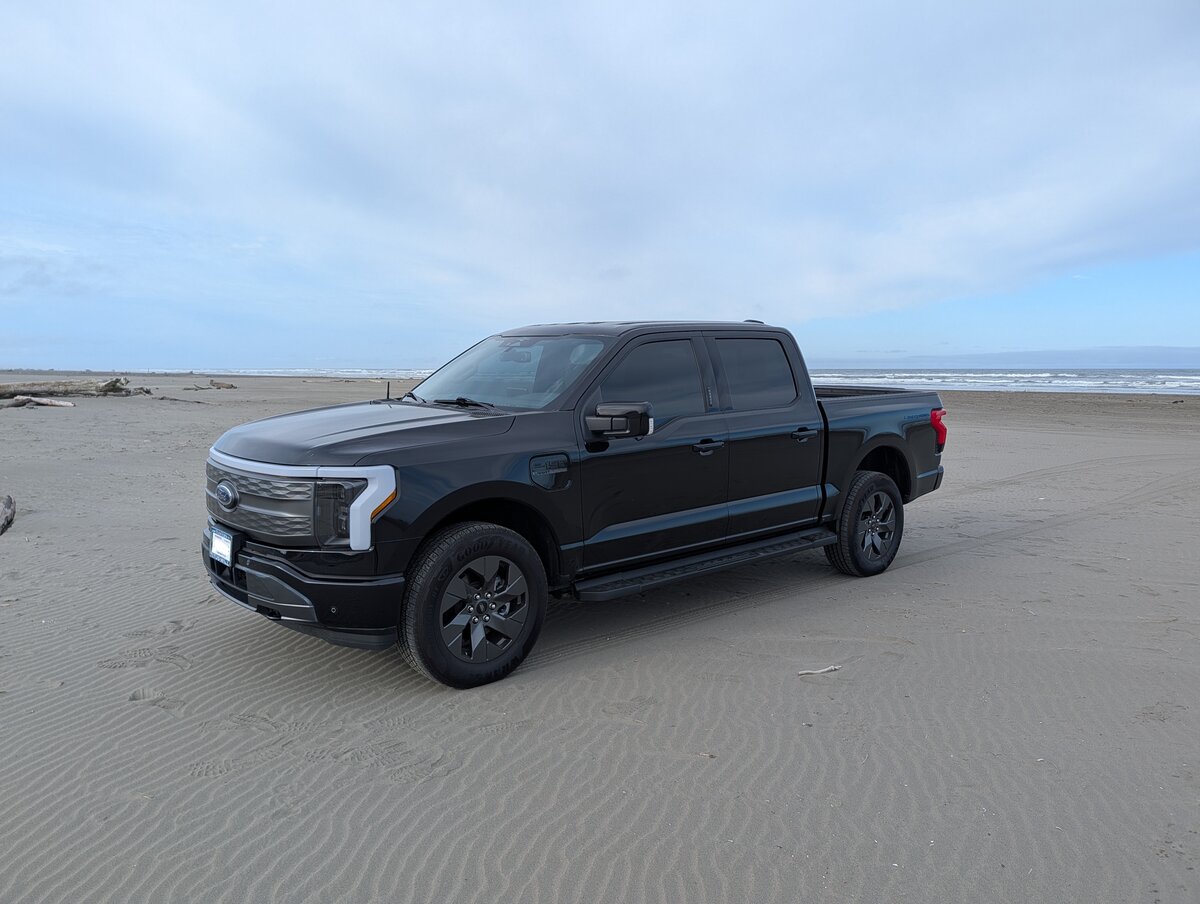
So I recently got a new vehicle: an F-150 Lightning. This may look like a review, but it’s more like a brain dump of all the things that have been bouncing around my head about it in the last few months.
This may also be an attempt to stop driving Vanessa crazy with sentences starting with “My truck…” :).
What did I want⌗
How did I end up with the Lightning? Well, I’ve wanted an EV for a long time, but have found myself generally unhappy with the options on the market. I like having a truck because I use the space for my weekly deliveries for the Emergency Food Network and the bed is nice for being able to move around larger items.
My previous vehicle was a 2020 Toyota Tacoma with ~26,000 miles. I knew, when I bought it, I wouldn’t replace it unless it was with an EV. The Tacoma is a great gas truck. In fact, the ability to hold its value enabled this transaction; I got basically what I paid for it in December 2019 (lucky timing) for trade-in credit.
So that gets into the second part: why do I want an EV? There’s a few reasons, but at a base level I like the logistical sense of an electric vehicle. My house is already connected to the grid. Almost anywhere I go is already connected to the grid. As Technology Connections says: “Did you know [PLACE] has ELECTRICITY!?”. For me, as a resident of Washington, it’s extra nice – my electricity is generated hydroelectrically and is extremely cheap ($0.091/kWh).
Now we get to the final item: I wanted to buy used. Electric vehicles tend to depreciate quickly – that means that it’s almost more important to avoid the hit of buying new than for gasoline cars. Most EVs have a clear way for you to check the battery “state of health” which can give you a good sense of remaining battery life.
Shopping⌗
So: I wanted a used EV truck. That leaves an extremely limited set of choices. First, the makes I didn’t strongly consider:
- Chevy Silverado EV (and other GM equivalents) - As a matter of principle, I avoid vehicles that do not allow Android Auto phone mirroring. I am not OK with being locked-in to car software that will never have the quality of support my Pixel phone does.
- Tesla Cybertruck - It’s ugly. It’s huge. It’s impractical. It’s expensive. I don’t want to give money to Elon Musk.
There were two that I strongly considered and test drove. The Rivian R1T, and the F-150 Lightning. My main concern with both was size – I didn’t want a full-size truck, even though those were the only real EV options.
I first looked at a used Rivian R1T Quad-motor at a local used car dealership. The vehicle had around 55,000 miles and was in decent shape. Some things I liked about the Rivian were the adjustable stance (it would “kneel” the suspension to make it easier to enter), and the long-term software support cycle. The thing I didn’t like was the price wasn’t great for the value (this is true new; but was also true in the case of this particular truck). Also it was missing a lot of the small “niceties” like the integrated flashlights and bluetooth speakers… and key fobs (don’t worry, the used car salesman assured me, as he struggled - as I did - to get the janky NFC card “key” to work).
I took it on a test drive and found out I didn’t like it very much. It’s slightly smaller on the exterior than the F-150 Lightning, but the interior felt significantly smaller. There were a lot of minor things which I didn’t like including something as simple and important as the handle by the door – on the Rivian, it is on the headliner above the door, which made it useless for my small wife to use to help get into the truck. I liked the truck okay, but it wasn’t ideal. I ended up making a low-ball offer on the truck which was rejected as expected. I’m glad they didn’t accept it.
Next, I looked at a Lightning. I had test driven one before the Rivian, and really appreciated the interior. It was spacious and comfortable, and lots of storage space – especially with the rear seats folded up. That test drive reinforced my concerns about it being large as it felt incredibly unwieldy especially in the dealership parking lot. I decided to give it another chance and take it on another drive. After reflection, I decided I’d most likely get used to the large size of the vehicle and appreciate the comfort of the larger interior. The specific truck I ended up with was a 2023 F-150 Lightning Lariat with 15.5k miles and 98% battery state of health.
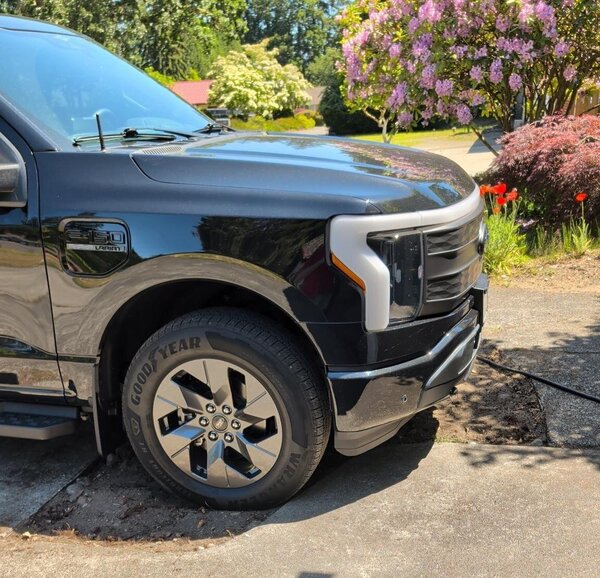
Ford being a traditional car company that committed to 10 years of parts and support made me not worry about the cancellation of the Lightning line. By that point, I had seen videos of service done to them and was convinced that, at least in the PNW, if I had to get it serviced by a third party that an independent shop would and could fix it.
Buying⌗
Now that the truck was selected, I purchased it. Despite paying cash, it took over two hours at the dealership to get checked out. I’ll never understand how these things can take so long. I ended up taking the truck home with a very low state of charge – the dealership’s DC Fast Charger (DCFC) was offline. The next day I ended up charging it at an EVgo charger right down the road from me (it’s well hidden; I didn’t know it existed before then!).
With an EV purchase you’re not done – one tenet of ownership is that if possible, you must be able to charge at home. This means, for most people, installing EV Supply Equipment (EVSE). These are essentially just smart switches which communicate with your car and monitor safety – the AC/DC conversion happens inside your vehicle. Luckily, even though Trump killed the EV purchase tax credits, I made it in just before the deadline to get 30% of the cost of the install back as a federal tax credit. Also, Tacoma Power is giving me a $600 bill credit since I proved I installed it.
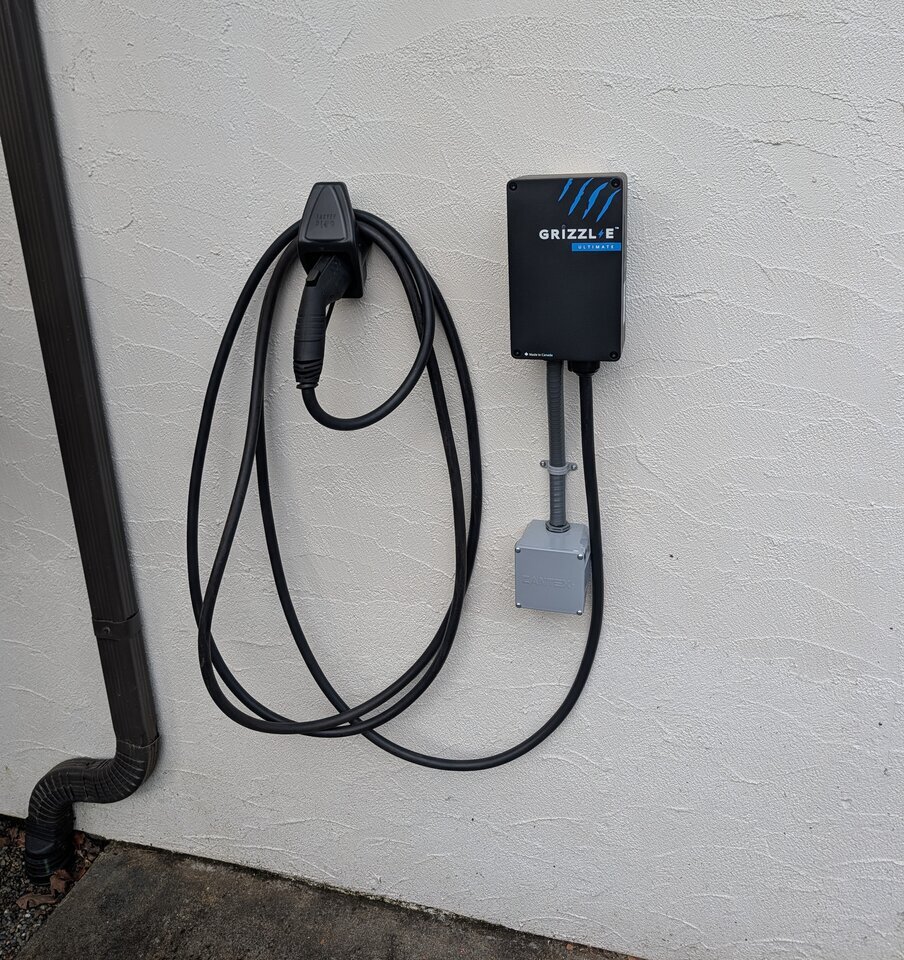
I contacted a local electrician, Skipper and Sons, to install a Grizzl-E 48 amp charger. Because my truck is stored outside, it’s hanging off the outside of the house. Charging is safe in any weather; although most people use a shield for snow/ice to prevent physical cable icing. After the credits, the install and equipment ended up costing me around $500 out of pocket (and of course; I don’t see the tax credit until next year).
Ownership Experience⌗
So now I’ve had my truck for about two and a half months; how has it been?
First, let’s address my dangling concern: the size. It’s still a big concern. It’s not trivial to get it around in parking garages or in downtown Seattle. The turning radius is huge. As much of a negative as it can be though, the spacious interior is amazing. For my weekly food bank deliveries, I can fit all the food inside the cab of the truck. No more worrying about rain. I wish it was smaller; but I’m learning how to deal.
What about the day-to-day of owning an EV? Well, it’s pretty nice. I did a lot of research and found that for my particular EV, I should charge it daily to a limit of 90%. Charging a little every day – even when I’ve barely touched the battery – keeps each charge shallow, which is gentler on it than running it down and charging back up in big chunks. For most day-to-day usage, I don’t even think about it – I just do what I want, come home, and plug in. I’ve spent about $60 so far on electricity at home to charge the truck in two and a half months.
The truck itself is a joy to drive. That, combined with a particularly stressful time at work, has led me to go on a series of road trips. I’ve taken the truck to lots of beautiful landmarks around me I’ve never been to before, and DCFC as needed. It’s a really comfortable truck to drive, really responsive on the throttle, and I’ve had zero problems in the five fast charging sessions I’ve had so far.
The Math⌗
So what’s the math look like for operating cost for an EV vs a gas vehicle? First of all, most EVs require significantly less maintenance – there’s no oil to change periodically, and for most EVs I’ve researched, their service interval is every 10,000 miles. But for simplicity; let’s just talk about electricity. I’m going to use my local prices for everything but the formulas are what matter.
With a gas car, you have a few things you think about:
- Miles per Gallon (efficiency)
- Price per Gallon of gas (fuel price)
- Size of Gas Tank (fuel storage)
The EV equivalents are:
- Miles per kilowatt-hour (efficiency)
- Price per kilowatt-hour (AC Slow Charging at home)
- Price per kilowatt-hour (DC Fast Charging)
- Size of Battery (fuel storage)
We can extrapolate range from these numbers:
- Range (fuel storage) * (efficiency)
So my truck is a Ford F-150. It’s not efficient. At highway speeds, I typically get 2.0 mi/kWh. I have the standard range, which is rated for 98 kWh. Let’s plug in all the appropriate numbers for my old and new truck to give us a concrete example. For fun I’m going to add my wife’s Honda Civic.
| Vehicle | Efficiency | Price (slow) | Price (fast) | Storage | Range |
|---|---|---|---|---|---|
| 2020 Toyota Tacoma SR 5 4WD | 20 MPG | $5.50/gal | $5.50/gal | 21.1 gal | 21.1 gal x 20 MPG = 422 miles |
| 2023 Ford F-150 Lightning | 2.0 mi/kWh | $0.091/kWh | $0.55/kWh | 98 kWh | 2.0 mi/kWh x 98 kWh = 196 miles |
| 2016 Honda Civic EX | 35 MPG | $5.50/gal | $5.50/gal | 12.4 gal | 12.4 gal x 35 MPG = 434 miles |
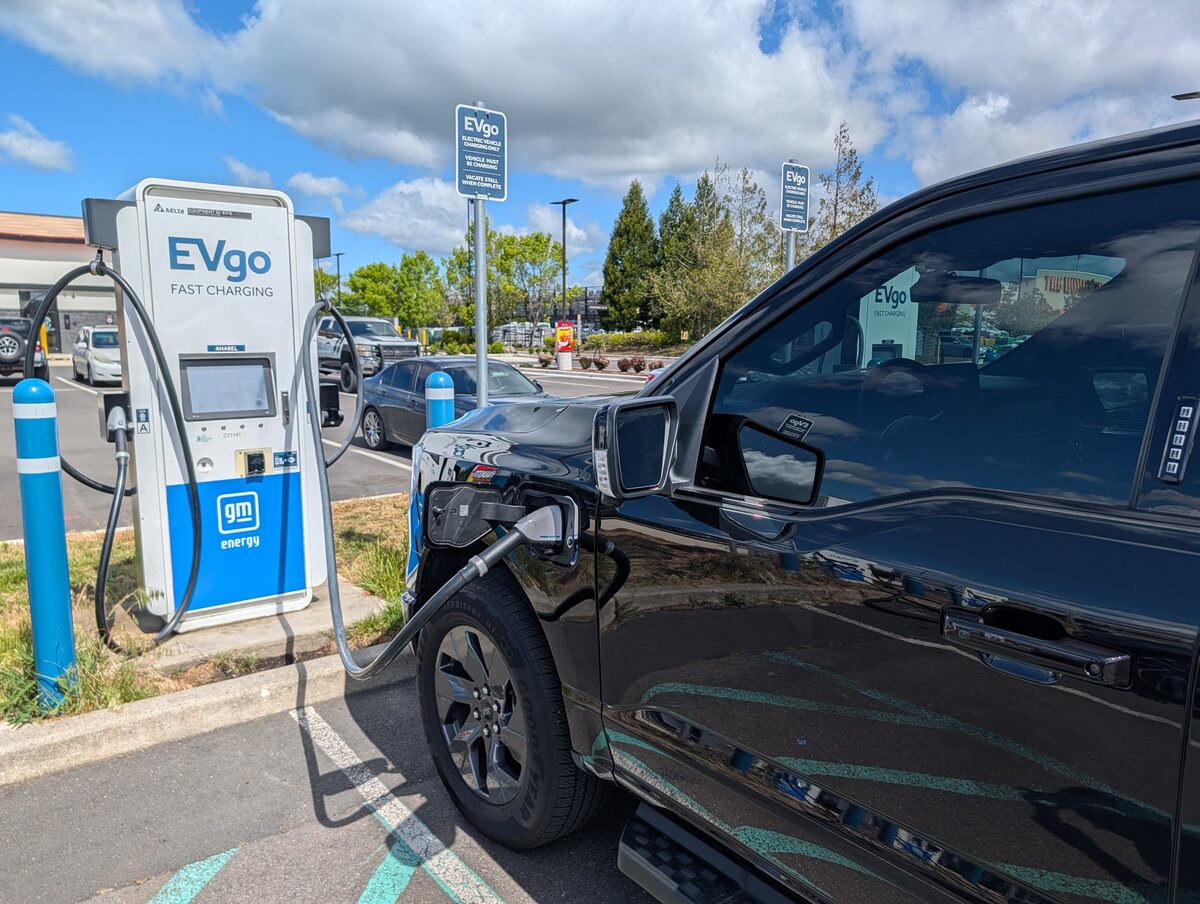
Now – a note here for something that bamboozled me when buying my truck. Luckily for my use case it doesn’t matter but it may for yours. Just like you might not run a gas tank down to “E”, most EV drivers won’t take their EV below 10%. Additionally, when charging at a DCFC, charging above 80% slows down considerably and usually is bad for the battery. This means that the useful range – the amount I’m actually going between charging trips – in my truck is closer to 140 miles. That’s about how far I can go from 80% -> 10%.
So now, let’s break down the longest of my recent trips – to Ocean Shores, WA. It’s approximately 100 miles, one way, from the house.
Let’s setup a cost comparison table for the round trip:
| Vehicle | Total cost | Range Notes |
|---|---|---|
| Tacoma | 200/20 = 10 gal * $5.50/gal = $55.00 | Would use less than half a tank. |
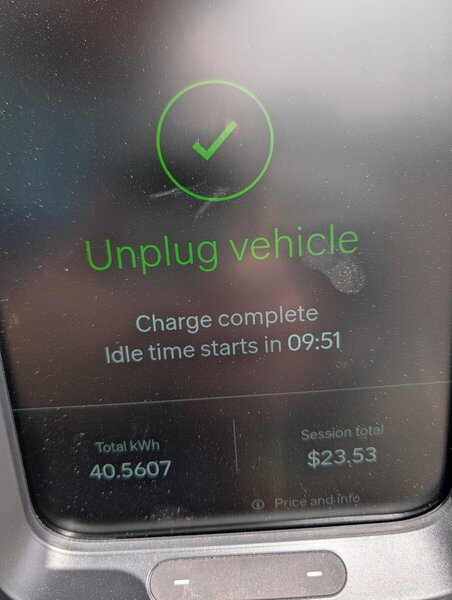
| Lightning | 200/2.0 = 100 kWh. (60 kWh*.091)+(40 kWh*.55) =$27.46 | One 15 minute charging stop. |
| Civic | 200/35 = 5.71 gal * $5.50/gal = $31.43 | Would use about half a tank. |
For this trip I charged 40 kWh at the DCFC, but as little as 20 kWh would’ve been enough – if you were price sensitive, you could get cheaper rates and use less DCFC overall to get out cheaper. Really though, the value of an EV shines when you’re charging at home – it’s so cheap. DCFC prices usually end up cheaper for “like for like” vehicles, but the Lightning is a giant truck, and while it may be battery powered, it’s still inefficient.
Future Plans⌗
I doubt I’d ever own anything but an EV in the future. The experience has been great, I love the quiet cabin and no smell of gas.
I still don’t want something this big. Ford is coming out with a medium-sized EV truck next year. If I like the specs and how it looks, I might make it the last vehicle I ever purchase. If not, I foresee keeping my Lightning until something Tacoma/Ranger size exists in the EV world.
Feel free to reach out on Mastodon if you want to chat some about this. I’m sure I can talk your ear off.
Relevant Links⌗
There are some creators and websites I’ve started using to research about this. Linking them here.
Routing/Charging Planning
- ABRP - A tool to plan EV roadtrips, including charging stops and real-world range estimates based on cars. You can even hook up an OBD bluetooth dongle in your car and have it do realtime adjustments based on actual power usage and battery remaining.
- PlugShare - Basically social reviewing and indexing of charging sites. Unless I have no other option, I won’t use a charger unless it’s well-rated on Plugshare with recent check-ins.
Content Creators/Communities
- F-150 Lightning Forum - A real, old-school internet forum, like I used to frequent in the 2000s, but about my truck. Lots of useful information and a helpful community.
- Technology Connections - Has a ton of videos on EVs, renewables and generally making sense of the technology in our modern world.
- Transport Evolved - Interesting real-world stuff from running EVs, especially the lightning. Bonus that they are based in the PNW.
- Out of Spec - Lots of channels, and I don’t like all their stuff, but they had several videos around repairing old EVs, which helped give me confidence in how repairable they are.
Revisions⌗
| Version | Date | Description |
|---|---|---|
| 2 | 2026-06-08 | Added photos and minor formatting fixes. |
| 1 | 2026-06-06 | Initial version. |